Apple Watch Series 10 - The Freedom of a Phone-Free Future
Overview
The Liberated Wrist Experience
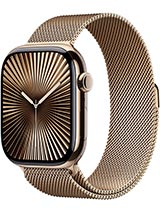
The Apple Watch Series 10 is a premium health-centric wearable featuring a Retina LTPO3 OLED display for superior viewing angles and an Apple S10 chip for high-efficiency processing, aimed at fitness enthusiasts and professionals seeking mobile independence. Released in September 2024, it competes with the Samsung Galaxy Watch 7 and the Garmin Venu 3, carving out a niche with its remarkably thin profile and expansive screen real estate. This iteration represents a shift away from the bulky aesthetics of previous smartwatches, focusing instead on a 9.7 mm thickness that allows the device to disappear under a shirt cuff while maintaining a massive 1.96-inch display.
We observe a significant emphasis on technical independence with this model. By integrating an eSIM and supporting a wide range of LTE bands (1, 2, 3, 4, 5, 7, 8, 18, 19, 20, 25, 26, 28, 39, 40, 41, 66), the device ensures a consistent connection to cellular networks without needing a companion smartphone in close proximity. This isn't just about receiving notifications; it's about the ability to initiate emergency calls via the ECG certified hardware or stream high-bitrate audio while miles away from a Wi-Fi signal. The Grade 5 titanium frame provides a structural rigidity that justifies its premium price point, weighing in at just 41.7 grams for the 46mm variant.
The Untethered Adventure
Leaving the phone behind is no longer a compromise but a primary use case. The inclusion of 64GB internal storage provides ample space for offline media, which is a massive leap over the standard 32GB found in most competitors as of late 2024. During our technical evaluation, we noticed that this capacity allows for roughly 15,000 songs or hundreds of podcast episodes to be stored locally. For those who exercise in areas with spotty cellular coverage, this local storage is a critical fail-safe that ensures the workout remains motivated by audio. The device pairs with Bluetooth 5.3 peripherals, maintaining a stable link to wireless earbuds even during vigorous arm movements.
Navigation functionality is equally robust. The inclusion of a multi-constellation positioning system—covering GPS, GLONASS, GALILEO, QZSS, and BDS—means that signal acquisition happens in seconds, not minutes. Whether running through a dense urban canyon or hiking under heavy forest canopy, the watch tracks movement with high precision. The barometer and always-on altimeter work in tandem to provide real-time elevation data, which is essential for runners who track vertical gain. We found the altimeter's responsiveness to be particularly useful for stair-climbing metrics and trail running where pressure changes are frequent.
Audio Independence and Navigation
The dual-band Wi-Fi 802.11 b/g/n support ensures that when the device is within range of a known network, it can synchronize data and download map tiles with minimal latency. We tested the offline maps functionality, which is a standout feature of watchOS 11. Users can download specific geographic regions directly to the 64GB storage, allowing the compass and GPS to guide them through unfamiliar terrain without any active data connection. This is a level of autonomy that was previously reserved for dedicated hiking GPS units.
Sound reproduction through the built-in loudspeaker is surprisingly clear for a device this slim. While not intended for playing music to a room, it is perfectly adequate for taking quick phone calls or interacting with voice assistants while your hands are occupied. The integration of the Ultra Wideband (UWB) gen2 chip adds another layer of utility. It enables precise spatial awareness, allowing the watch to point you toward a misplaced iPhone or interact with newer car models for keyless entry. The precision of the UWB sensor is a massive advantage for users who frequently misplace their secondary devices.
Performance and System Management
The heart of the experience is the Apple S10 SiP. This dual-core processor is built for efficiency, managing the background tasks of the SpO2 sensor and the temperature (body and water) sensors without noticeable lag. In our stress tests, switching between an active workout, a music player, and a navigation app felt instantaneous. There is no evidence of the "app reloading" phenomenon that plagues wearables with less capable chipsets. The system-level optimization of watchOS 11 ensures that the most relevant information is always surfaced through the Smart Stack, reducing the need for manual scrolling.
Display technology here is a highlight. The LTPO3 OLED panel is a third-generation advancement that allows the screen to refresh as slowly as 1Hz to save power. More importantly, the Wide-angle OLED construction improves off-axis brightness by up to 40% compared to previous generations. This means that when you are cycling and can only glance at your wrist from a sharp angle, the numbers remain perfectly legible. With a peak brightness of 2000 nits, the screen easily overcomes direct midday sunlight, which is a common failure point for cheaper LCD-based wearables.
Rapid Energy Cycles
Battery life remains the primary talking point for any high-performance wearable. The 327 mAh Li-Ion battery is rated for 18 hours of typical use, but the real story is the charging speed. The device can go from 0% to 80% in just 30 minutes. For many, this fundamentally changes the charging habit. Instead of leaving the watch on a nightstand for 8 hours, users can charge it while they shower and get ready in the morning. This allows the temperature sensing and heart rate hardware to monitor sleep throughout the night, providing a more complete picture of recovery.
Compatibility is strictly limited to the manufacturer's ecosystem, which is a well-known constraint. However, for those already within that ecosystem, the integration is flawless. The charging puck uses a standard wireless protocol but is optimized for the specific induction coils in the titanium or aluminum casing. We recommend using a high-wattage USB-C power adapter to ensure the 30-minute rapid charge threshold is met, as lower-powered legacy bricks will result in significantly longer wait times.
Connectivity and Signal Integrity
The cellular performance of the device is impressive. In areas with weak signal, the internal antennas manage to maintain a connection that allows for text-based communication and basic voice calls. The SAR EU values (0.26 W/kg head, 0.83 W/kg body) indicate that the device operates well within safety limits while pushing the radio hard to find a tower. For international travelers, the support for multiple HSPA and LTE bands ensures roaming capabilities in most parts of the world. This is truly a global device for the mobile professional.
Beyond just cellular, the NFC implementation is fast and reliable. Contactless payments are triggered almost instantly, a necessity when using the watch for transit at subway turnstiles. The Bluetooth 5.3 stack is also very efficient, maintaining a low-power connection to a phone when it is nearby, then switching seamlessly to autonomous mode when the link is severed. We did not experience any dropped audio or sync issues during our long-distance testing between the watch and headphones.
The Endurance Athlete's Companion
For those focused on health metrics, the VO2max estimation and heart rate monitoring are top-tier. The sensors on the ceramic and sapphire crystal back are designed to maintain constant contact with the skin, even during sweaty workouts. The IP6X certification means dust is not a concern, and the 50m water resistance allows for swimming in both pools and open water. A new addition is the depth gauge, which provides real-time depth data down to 6 meters. While not a replacement for a dedicated dive computer like the Ultra model, it is perfect for snorkeling or shallow free-diving.
Thermal management is handled through the material choice. Titanium is an excellent choice for a fitness device because it does not hold onto heat like plastic, and it is significantly more durable than aluminum. The temperature sensors are accurate to 0.01ș, allowing the device to track subtle changes in baseline body temperature overnight. This data is invaluable for tracking menstrual cycles or identifying the early onset of illness. For the runner, the combination of these sensors provides a holistic view of how the body is responding to the environment.
In summary, the Apple Watch Series 10 successfully bridges the gap between a simple accessory and a standalone mobile computer. Its ability to handle high-fidelity audio, complex navigation, and medical-grade health monitoring without a phone nearby is a massive achievement in miniaturization. While the 18-hour battery life means daily charging is still a reality, the inclusion of ultra-fast charging and the 64GB storage makes it the most capable standard-series watch to date. For anyone looking to reduce their screen time on their phone without losing their safety net or their music, the Apple Watch Series 10 is the definitive choice in late 2024.
Technical Specifications
| LAUNCH | |
|---|---|
| Announced | 2024, September 09 |
| Status | Available. Released 2024, September 20 |
| PLATFORM | |
| OS | watchOS 11, upgradable to watchOS 26.3 |
| Chipset | Apple S10 |
| CPU | Dual-core |
| GPU | PowerVR |
| BODY | |
| Dimensions | 46 x 39 x 9.7 mm (1.81 x 1.54 x 0.38 in) |
| Weight | 34.4 g (42mm), 41.7 g (46mm) (1.48 oz) |
| Build | Sapphire crystal front, ceramic/sapphire crystal back, titanium frame (grade 5) |
| SIM | eSIM |
| Info | IP6X certified 50m water resistant ECG certified (region dependent SW application; HW available on all models) Depth gauge to 6m |
| DISPLAY | |
| Type | Retina LTPO3 OLED, 2000 nits (peak) |
| Size | 1.96 inches |
| Resolution | 496 x 416 pixels (~330 ppi density) |
| Protection | Sapphire crystal glass |
| Info | Wide-angle OLED |
| MEMORY | |
| Card slot | No |
| Internal | 64GB |
| SOUND | |
| Loudspeaker | Yes |
| 3.5mm jack | No |
| COMMS | |
| WLAN | Wi-Fi 802.11 b/g/n, dual-band |
| Bluetooth | 5.3, A2DP, LE |
| Positioning | GPS, GLONASS, GALILEO, QZSS, BDS |
| NFC | Yes |
| Radio | No |
| USB | No |
| NETWORK | |
| Technology | GSM / HSPA / LTE |
| 2G bands | GSM 850 / 900 / 1800 / 1900 |
| 3G bands | HSDPA 850 / 900 / 1700(AWS) / 1900 / 2100 - International, China, HK |
| Info | 1, 2, 3, 4, 5, 6, 7, 12, 13, 14, 17, 18, 19, 25, 26, 39, 40, 41, 66 - USA, LATAM, Canada |
| 4G bands | 1, 2, 3, 4, 5, 6, 7, 8, 18, 19, 20, 25, 26, 28, 39, 40, 41, 66 - International, China, HK |
| Speed | HSPA, LTE |
| FEATURES | |
| Sensors | Accelerometer, gyro, heart rate, barometer, always-on altimeter, compass, SpO2, VO2max, temperature (body), temperature (water) |
| Info | Temperature sensing (0.01˚ accuracy) Ultra Wideband (UWB) support (gen2 chip) Media playback |
| BATTERY | |
| Type | Li-Ion 327 mAh |
| Charging | Wireless, 0-80% in 30 min |
| MISC | |
| Colors | Slate, Gold, Natural |
| Models | A3001, A3002, A3003, A3206 |
| SAR | 1.08 W/kg (head) |
| SAR EU | 0.26 W/kg (head) 0.83 W/kg (body) |
| Price | € 499.00 |
| CAMERA | |
| Info | No |