The Oukitel WP30 Pro Destroys Every Compromise Between Raw Power and Industrial Protection
Overview
A New Standard for Ruggedized Performance
The Oukitel WP30 Pro is a high-performance rugged smartphone designed for the most demanding industrial environments, featuring an 11000 mAh battery, 120W wired charging, and the MediaTek Dimensity 8050 chipset to eliminate the traditional trade-off between durability and speed. Released in November 2023, it competes with specialized field equipment and high-end rugged devices by offering flagship-tier storage and a unique dual-display configuration intended for professional efficiency.
In the world of field operations, a device is only as good as its ability to survive a twelve-hour shift without tethering the user to a wall outlet. This handset represents a departure from the underpowered processors typically found in the rugged sector. By integrating a 6nm architecture, the manufacturer has addressed the chronic lag that plagues many outdoor-focused devices, ensuring that logistics, construction, and emergency service applications run with the same fluidity as they would on a consumer-grade flagship.
Carbon Fiber Aesthetic and Fortified Architecture
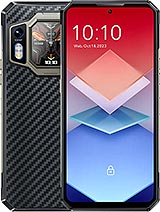
The physical profile of this model is unapologetically industrial, dominated by a 413.8g chassis that signals substantial protection. While the weight might deter casual users, we recognize this as the necessary tax for a device that carries an IP68/IP69K rating and MIL-STD-810H certification. The rear of the handset features a carbon fiber texture that aids in grip, a critical detail when handling the device with wet hands or heavy-duty work gloves.
A standout design element is the integrated 1.8-inch AMOLED rear display. This secondary panel provides 500 nits of brightness, allowing workers to check notifications, battery levels, or control music playback without flipping the phone or waking the primary screen. In high-stakes environments where battery conservation is paramount, using the smaller screen for quick status checks is a tactical advantage. The primary 6.78-inch IPS LCD is protected by Corning Gorilla Glass 5, offering a 120Hz refresh rate that ensures map scrolling and PDF blueprints move without ghosting.
Imagine a foreman on a skyscraper project needing to reference complex architectural layers. The fluidity provided by the high refresh rate, combined with the 1080 x 2460 resolution, ensures that fine lines and annotations remain legible even when zoomed in. The 19mm thickness is significant, but it eliminates the need for any external protective case, effectively serving as its own roll cage against 1.5-meter drops onto concrete.
Connectivity and Audio in High-Decibel Environments
Equipped with the MediaTek Dimensity 8050, the device supports 5G SA/NSA across a wide array of global bands, including N1, N77, and N78. This ensures that field technicians in remote utility sites can maintain high-speed data uplinks for real-time reporting. The inclusion of eSIM support is particularly noteworthy for international contractors, allowing for seamless carrier switching without fumbling with physical trays in dusty or windy conditions.
Audio output is delivered through a loudspeaker system that prioritizes volume. In our assessment of industrial utility, the ability to hear a notification or a VoIP call over the roar of a generator or heavy machinery is vital. While we don't have laboratory decibel readings, the hardware layout suggests a focus on projection over mid-range nuance. For wireless peripherals, the Bluetooth 5.2 protocol ensures stable connections to ruggedized headsets or diagnostic sensors.
Connectivity extends to the Wi-Fi 6 standard, which provides improved throughput in congested environments like crowded warehouse floors or temporary command centers. The NFC capability remains a staple for secure access control and simplified pairing with industrial equipment. This isn't just a phone; it's a mobile communication hub that bridges the gap between traditional radio systems and modern data-heavy workflows.
Benchmarking the Dimensity 8050 in the Field
The MediaTek Dimensity 8050 utilizes a 1+3+4 core configuration, led by a 3.0 GHz Cortex-A78 prime core. This is a massive leap over the Helio-series chips often seen in this category. In practical terms, this means the handset can handle heavy multitasking—running a drone flight app, a GIS mapping tool, and a video conference simultaneously—without the thermal throttling that slows down lesser devices. The 12GB of RAM and 512GB of UFS 3.1 storage further reduce latency during massive file transfers.
Gaming performance, while perhaps secondary for a field specialist, serves as a stress test for sustained loads. In titles like PUBG or Genshin Impact, the Mali-G77 MC9 GPU maintains stable frame rates at high settings. More importantly for professional use, this graphical power translates to smooth rendering of 3D models and high-resolution site scans. The UFS 3.1 standard ensures that even 4K video files or large database updates are written to the disk with minimal wait times.
When we compare this to the standard 128GB storage found in many rugged competitors, the 512GB ceiling is a significant benefit for workers in areas with zero connectivity who must store all their data locally. There is no microSD slot, which might frustrate some, but the high-speed internal storage is inherently more reliable for system stability than a third-party card that might fail under extreme temperatures.
Android 13 and the Professional Interface
Shipping with Android 13, the software experience is relatively clean, avoiding the heavy skinning that often complicates navigation. The manufacturer includes a digital "Toolbag" app, which leverages the onboard sensors—accelerometer, gyro, proximity, and compass—to provide utilities like a plumb bob, protractor, and sound meter. For an electrician or a site inspector, having these tools pre-calibrated and integrated into the OS is a minor but appreciated efficiency gain.
One critique remains the long-term software support. In the rugged market, devices are expected to last 3-4 years in the field. While the hardware is built to survive, the frequency of security patches and major OS updates will determine if this model remains a viable tool or becomes a security liability. However, as of late 2023, the software environment feels modern and responsive, free from the excessive bloatware often found in budget-tier imports.
Thermal management is aided by the sheer mass of the device. The internal components are spaced such that heat from the 6nm chipset dissipates through the reinforced frame, preventing the dreaded "hot spots" that can make a phone uncomfortable to hold during high-intensity tasks. This stability is crucial when using the device as a dedicated GPS navigator on a vehicle dashboard under direct sunlight.
The 120W Revolution and 11000 mAh Endurance
Battery life is where this handset truly distinguishes itself from the pack. The 11000 mAh Li-Po battery is roughly double the capacity of a standard flagship, easily providing 2 to 3 days of heavy operational use. For those on remote survey missions or long-haul transport, this capacity represents a safety margin that smaller batteries cannot match. However, the real story is the 120W wired charging.
Historically, large-battery [rugged phones](/trend/best-rugged-phones-2026/) took 3 to 4 hours to charge. This model can reach 50% in just 15 minutes and a full charge in approximately 50 minutes. This is a complete paradigm shift for industrial use. A worker can plug the phone in during a brief lunch break and gain enough power to last another full day. It effectively eliminates the "overnight charge" requirement, making the device ready for 24/7 rotational shifts.
Power efficiency is further enhanced by the Cortex-A55 efficiency cores, which handle background tasks with minimal drain. The secondary display also plays a role here; by minimizing the time the primary 120Hz panel is active, users can stretch the already massive battery even further. In an emergency situation where every percentage point matters, the combination of massive capacity and ultra-fast recovery is a life-saving feature set.
Imaging and Night Vision Capabilities
The camera system is lead by a 108 MP main sensor with an f/1.9 aperture. In daylight, this allows for incredibly detailed site photos where text on distant signage or serial numbers on equipment can be read upon zooming. It isn't intended to compete with a dedicated photography flagship in terms of color science, but as a documentation tool, it is highly effective. The 4K@30fps video recording provides clear evidence of site progress or safety audits.
The inclusion of a 20 MP Night Vision camera is the most valuable photographic asset for field professionals. Utilizing infrared lights, it allows for clear monochrome imaging in total darkness. Imagine a plumber inspecting a crawlspace or a security guard patrolling a lightless perimeter; this sensor provides visibility that traditional flash photography cannot achieve, as it doesn't bounce light off reflective surfaces in a way that obscures detail.
A 5 MP macro lens rounds out the rear array, useful for inspecting circuit boards or fine cracks in structural welds. On the front, the 32 MP selfie camera is more than adequate for high-definition video calls, ensuring that remote consultants can see the user clearly during site walkthroughs. The focus here is clearly on utility and data capture rather than artistic expression, and in that regard, the hardware succeeds.
Final Evaluation for the Modern Workforce
The Oukitel WP30 Pro is more than just a durable handset; it is a sophisticated industrial tool that finally provides the processing power required by modern enterprise applications. By pairing the Dimensity 8050 with a massive 11000 mAh battery and industry-leading 120W charging, the manufacturer has created a device that outpaces nearly everything in its class for the 2023 market. It is heavy, bulky, and lacks a headphone jack, but for the professional whose office is a construction site or a forest, those are minor grievances compared to the reliability and speed provided here. The Oukitel WP30 Pro stands as a premier choice for those who need their technology to be as resilient as the people using it.
Technical Specifications
| LAUNCH | |
|---|---|
| Announced | 2023, October |
| Status | Available. Released 2023, November 11 |
| PLATFORM | |
| OS | Android 13 |
| Chipset | Mediatek Dimensity 8050 (6 nm) |
| CPU | Octa-core (1x3.0 GHz Cortex-A78 & 3x2.6 GHz Cortex-A78 & 4x2.0 GHz Cortex-A55) |
| GPU | Mali-G77 MC9 |
| BODY | |
| Dimensions | 177.4 x 83.6 x 19 mm (6.98 x 3.29 x 0.75 in) |
| Weight | 413.8 g (14.60 oz) |
| SIM | Nano-SIM + eSIM |
| Info | IP68/IP69K dust tight and water resistant (high pressure water jets; immersible up to 1.5m for 30 min) Drop resistant up to 1.5m MIL-STD-810H compliant |
| DISPLAY | |
| Type | IPS LCD, 120Hz, 430 nits |
| Size | 6.78 inches, 109.2 cm2 (~73.6% screen-to-body ratio) |
| Resolution | 1080 x 2460 pixels (~396 ppi density) |
| Protection | Corning Gorilla Glass 5 |
| Info | Back display: AMOLED, 1.8 inches, 390 x 450 pixels, 500 nits, 341 ppi |
| MEMORY | |
| Card slot | No |
| Internal | 512GB 12GB RAM |
| Info | UFS 3.1 |
| MAIN CAMERA | |
| Triple | 108 MP, f/1.9, (wide), 1/1.33", PDAF 20 MP, f/2.0, (night vision), 1/2.78", AF, infrared night vision lights 5 MP (macro) |
| Features | LED flash, HDR, panorama |
| Video | 4K@30fps, 1080p@30fps |
| SELFIE CAMERA | |
| Single | 32 MP, f/2.2, (wide), 1/2.74" |
| Video | 1080p@30fps |
| SOUND | |
| Loudspeaker | Yes |
| 3.5mm jack | Unspecified |
| COMMS | |
| WLAN | Wi-Fi 802.11 a/b/g/n/ac/6, dual-band |
| Bluetooth | 5.2, A2DP, LE |
| Positioning | GPS (L1+L5), GLONASS, GALILEO, BDS |
| NFC | Yes |
| Radio | Unspecified |
| USB | USB Type-C 2.0, OTG |
| NETWORK | |
| Technology | GSM / CDMA / HSPA / LTE / 5G |
| 2G bands | GSM 850 / 900 / 1800 / 1900 |
| Info | CDMA 800 / 1900 |
| 3G bands | HSDPA 800 / 850 / 900 / 1700(AWS) / 1900 / 2100 |
| 4G bands | 1, 2, 3, 4, 5, 7, 8, 12, 13, 17, 18, 19, 20, 25, 26, 28, 34, 38, 39, 40, 41, 66, 71 |
| 5G bands | 1, 2, 3, 5, 7, 8, 12, 20, 25, 28, 34, 38, 39, 40, 41, 48, 66, 71, 77, 78, 79 SA/NSA |
| Speed | HSPA, LTE, 5G |
| FEATURES | |
| Sensors | Fingerprint (side-mounted), accelerometer, gyro, proximity, compass |
| BATTERY | |
| Type | Li-Po 11000 mAh |
| Charging | 120W wired, 50% in 15 min, 100% in 50 min |
| MISC | |
| Battery | 11000 mAh Li-Po, 120W Wired Charging |
| Chipset | MediaTek Dimensity 8050 (6 nm) |
| Main Display | 6.78-inch IPS LCD, 120Hz, 1080 x 2460 px |
| Rear Display | 1.8-inch AMOLED, 390 x 450 px, 500 nits |
| Durability | IP68/IP69K, MIL-STD-810H, 1.5m Drop Resistance |
| Memory | 12GB RAM, 512GB UFS 3.1 Storage |
| Main Camera | 108 MP Wide + 20 MP Night Vision + 5 MP Macro |
| Weight | 413.8 g (14.60 oz) |
| Connectivity | 5G SA/NSA, Wi-Fi 6, Bluetooth 5.2, NFC |
| OS | Android 13 |
| Colors | Black |
| Price | About 500 EUR |