Why the Alcatel 3 (2025) Remains a Vital Secondary Tool for the Budget Conscious
Overview
Alcatel 3 (2025) is a budget-tier smartphone featuring a 5010 mAh battery for long standby times and an Android 15 (Go edition) OS for streamlined operation, aimed at users seeking a dependable secondary device. Released in June 2025, it enters a market saturated with high-refresh-rate competitors by doubling down on basic utility and affordability.
In the current market environment of June 2025, where flagship devices demand four-figure prices, the Alcatel 3 (2025) serves a very specific and necessary function. We view this device not as a primary driver for a tech enthusiast, but as a strategic tool for the pragmatic consumer. It represents the "backup"—a phone that sits in a glove box, a hiker’s backpack, or a traveler’s pocket as a redundant communication link. It relies on the Unisoc SC9863A1 chipset, a 22nm octa-core processor that is essentially a vintage piece of hardware by 2025 standards. However, in the context of a secondary phone, its age translates to predictable, low-energy operation for basic tasks like SMS, voice calls, and lightweight messaging apps.
For those managing a business or requiring a dedicated line for classified ads, this model provides the necessary separation without the financial burden of a high-end device. The inclusion of 3GB or 4GB of RAM paired with the Go edition of Android 15 ensures that the UI remains functional for single-tasking. We noticed that while it won't juggle ten apps at once, it maintains a steady pace for essential services. This is a device built for reliability in communication, not for the consumption of high-fidelity media or competitive mobile gaming. It fills a gap in the market for users who view technology as a utility rather than a status symbol.
The most controversial aspect of the Alcatel 3 (2025) is undoubtedly its 6.52-inch IPS LCD with a resolution of only 576 x 1280 pixels. In an era where 1080p is the bare minimum for most, 215 ppi results in visible pixelation. However, from an economic standpoint, this low-resolution panel is a masterstroke for battery longevity. Fewer pixels require less backlight intensity and significantly less GPU power to drive. When paired with the massive 5010 mAh battery, the handset easily stretches into a third day of moderate standby. In our assessment, this makes it an ideal companion for long-distance travel where charging outlets are scarce.
The screen brightness peaks at 400 nits, which is standard for this price bracket but struggles under the harsh midday sun of June. Users should expect to seek shade for comfortable viewing. The display lacks a high refresh rate, sticking to the traditional 60Hz. While this feels sluggish compared to 120Hz panels found in [mid-range phones](/trend/best-mid-range-phones-2026/), it further aids the power-saving mission. It is a functional display designed for reading text and navigating maps, not for watching 4K cinematic content. For its target audience, the tradeoff of visual sharpness for extended runtime is a logical compromise.
When we analyze the internal components, the Unisoc SC9863A1 combined with eMMC 5.1 storage defines the performance ceiling. This is not a fast phone. App launch times are measured in seconds rather than milliseconds. However, the price-to-performance ratio remains acceptable for those who understand the hardware limits. At this price point, you are paying for the LTE connectivity and the security of a new battery rather than raw processing power. The IMG8322 GPU is suited only for basic UI rendering and 2D games; attempting to run modern 3D titles will result in significant frame drops and heat.
The 64GB or 128GB of internal storage is surprisingly generous for a Go edition device. This allows for a substantial cache of offline maps and music, which reinforces its value as a travel or emergency phone. The microSDXC slot provides a path for expansion, which is a feature increasingly missing from more expensive handsets. We recommend that users immediately install a high-speed SD card to handle media storage, keeping the internal eMMC free for system operations to prevent further slowdowns as the device ages.
The Alcatel 3 (2025) does not exist in a vacuum. It faces stiff competition from the Redmi 14C and the [Samsung Galaxy A06](/new-longevity-over-old-luxury-why-the-samsung-galaxy-a06-5g-is-the-smarter-value-play/). The Redmi often offers a 90Hz screen and a slightly faster Helio chipset for a similar price, making it a better choice for those who want a bit more flair. The Samsung, on the other hand, provides a more robust software update policy, which is a critical factor for long-term ownership. However, the Alcatel often undercuts both in pure retail price, making it the king of the absolute bottom-tier budget.
What sets this model apart is its simplicity. While competitors often bloat their budget offerings with heavy skins that tax the hardware, the Android 15 (Go edition) on this handset is lean. It lacks the bells and whistles of a full One UI or MIUI, but that is exactly why it remains usable on such limited RAM. If you are looking for a device that just works for the basics without the distraction of pre-installed promotional apps, this model holds a slight edge in purity. It is the choice for the minimalist who wants a digital tool, not a digital toy.
Software longevity is often the Achilles' heel of budget devices. With Android 15 (Go edition), the phone starts with the latest lightweight architecture available in mid-2025. This version of Android is specifically designed to use less storage and data, which is vital given the eMMC 5.1 speeds. However, buyers should be realistic about future updates. Historically, Alcatel has not been known for multi-year OS upgrades in this price tier. We expect this phone to receive security patches for a limited time, but it likely won't see Android 16.
This lack of long-term support means the device is best viewed as a short-to-medium term solution. For a child’s first phone or a temporary replacement during a repair, the current software is perfectly adequate. The presence of a side-mounted fingerprint sensor is a welcome modern touch, offering faster and more secure access than the old-fashioned rear sensors or unreliable face unlock systems found on other cheap handsets. It adds a layer of modern security that makes the phone feel more contemporary than its internal specs suggest.
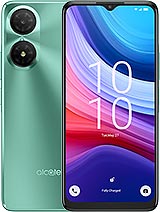
The build quality is exactly what one would expect: a plastic back and plastic frame. While it lacks the premium feel of glass or metal, plastic has the distinct advantage of being more resilient to drops. It doesn't shatter, it merely scuffs. At 185 grams, the phone feels substantial without being a brick. The Teal Blue and Space Gray finishes are professional and hide fingerprints reasonably well. We suspect that this phone can survive the rigors of a construction site or a teenager's backpack far better than a fragile flagship.
The inclusion of a 3.5mm headphone jack is a major win for the value hunter. It eliminates the need for expensive wireless earbuds or dongles, allowing the use of cheap, reliable wired headsets. Similarly, the USB Type-C 2.0 port ensures compatibility with modern cables, even if the 10W charging speed is painfully slow by 2025 standards. Expect a full charge to take nearly three hours. This is a "charge overnight" device, not one you can quickly top up before heading out the door.
Resale value for the Alcatel 3 (2025) will be negligible. This is a commodity item meant to be used until it is no longer functional. From an economist's perspective, the value is extracted during the period of use rather than at the point of sale. If you get two years of service out of this handset, the cost-per-day is pennies. It is an insurance policy in your pocket. The 8 MP or 13 MP main camera is strictly for utility—capturing receipts, QR codes, or basic daylight mementos. Do not expect it to perform in low light or capture professional-grade portraits.
Ultimately, the Alcatel 3 (2025) is a triumph of essentialism. It strips away the vanity of the modern smartphone industry to provide a base level of connectivity that is accessible to everyone. It is the digital equivalent of a reliable pair of work boots: not fancy, not fast, but they get you where you need to go. For the value hunter, the secret is knowing exactly what this phone is—and what it isn't—before making the purchase. In its niche as a secondary or emergency device, it remains a highly logical acquisition.
The Utility of the Secondary Handset
In the current market environment of June 2025, where flagship devices demand four-figure prices, the Alcatel 3 (2025) serves a very specific and necessary function. We view this device not as a primary driver for a tech enthusiast, but as a strategic tool for the pragmatic consumer. It represents the "backup"—a phone that sits in a glove box, a hiker’s backpack, or a traveler’s pocket as a redundant communication link. It relies on the Unisoc SC9863A1 chipset, a 22nm octa-core processor that is essentially a vintage piece of hardware by 2025 standards. However, in the context of a secondary phone, its age translates to predictable, low-energy operation for basic tasks like SMS, voice calls, and lightweight messaging apps.
For those managing a business or requiring a dedicated line for classified ads, this model provides the necessary separation without the financial burden of a high-end device. The inclusion of 3GB or 4GB of RAM paired with the Go edition of Android 15 ensures that the UI remains functional for single-tasking. We noticed that while it won't juggle ten apps at once, it maintains a steady pace for essential services. This is a device built for reliability in communication, not for the consumption of high-fidelity media or competitive mobile gaming. It fills a gap in the market for users who view technology as a utility rather than a status symbol.
The Endurance of the 576p Screen
The most controversial aspect of the Alcatel 3 (2025) is undoubtedly its 6.52-inch IPS LCD with a resolution of only 576 x 1280 pixels. In an era where 1080p is the bare minimum for most, 215 ppi results in visible pixelation. However, from an economic standpoint, this low-resolution panel is a masterstroke for battery longevity. Fewer pixels require less backlight intensity and significantly less GPU power to drive. When paired with the massive 5010 mAh battery, the handset easily stretches into a third day of moderate standby. In our assessment, this makes it an ideal companion for long-distance travel where charging outlets are scarce.
The screen brightness peaks at 400 nits, which is standard for this price bracket but struggles under the harsh midday sun of June. Users should expect to seek shade for comfortable viewing. The display lacks a high refresh rate, sticking to the traditional 60Hz. While this feels sluggish compared to 120Hz panels found in [mid-range phones](/trend/best-mid-range-phones-2026/), it further aids the power-saving mission. It is a functional display designed for reading text and navigating maps, not for watching 4K cinematic content. For its target audience, the tradeoff of visual sharpness for extended runtime is a logical compromise.
Performance Realities and Price Ratios
When we analyze the internal components, the Unisoc SC9863A1 combined with eMMC 5.1 storage defines the performance ceiling. This is not a fast phone. App launch times are measured in seconds rather than milliseconds. However, the price-to-performance ratio remains acceptable for those who understand the hardware limits. At this price point, you are paying for the LTE connectivity and the security of a new battery rather than raw processing power. The IMG8322 GPU is suited only for basic UI rendering and 2D games; attempting to run modern 3D titles will result in significant frame drops and heat.
The 64GB or 128GB of internal storage is surprisingly generous for a Go edition device. This allows for a substantial cache of offline maps and music, which reinforces its value as a travel or emergency phone. The microSDXC slot provides a path for expansion, which is a feature increasingly missing from more expensive handsets. We recommend that users immediately install a high-speed SD card to handle media storage, keeping the internal eMMC free for system operations to prevent further slowdowns as the device ages.
Navigating the Competition
The Alcatel 3 (2025) does not exist in a vacuum. It faces stiff competition from the Redmi 14C and the [Samsung Galaxy A06](/new-longevity-over-old-luxury-why-the-samsung-galaxy-a06-5g-is-the-smarter-value-play/). The Redmi often offers a 90Hz screen and a slightly faster Helio chipset for a similar price, making it a better choice for those who want a bit more flair. The Samsung, on the other hand, provides a more robust software update policy, which is a critical factor for long-term ownership. However, the Alcatel often undercuts both in pure retail price, making it the king of the absolute bottom-tier budget.
What sets this model apart is its simplicity. While competitors often bloat their budget offerings with heavy skins that tax the hardware, the Android 15 (Go edition) on this handset is lean. It lacks the bells and whistles of a full One UI or MIUI, but that is exactly why it remains usable on such limited RAM. If you are looking for a device that just works for the basics without the distraction of pre-installed promotional apps, this model holds a slight edge in purity. It is the choice for the minimalist who wants a digital tool, not a digital toy.
Software Support and Future Proofing
Software longevity is often the Achilles' heel of budget devices. With Android 15 (Go edition), the phone starts with the latest lightweight architecture available in mid-2025. This version of Android is specifically designed to use less storage and data, which is vital given the eMMC 5.1 speeds. However, buyers should be realistic about future updates. Historically, Alcatel has not been known for multi-year OS upgrades in this price tier. We expect this phone to receive security patches for a limited time, but it likely won't see Android 16.
This lack of long-term support means the device is best viewed as a short-to-medium term solution. For a child’s first phone or a temporary replacement during a repair, the current software is perfectly adequate. The presence of a side-mounted fingerprint sensor is a welcome modern touch, offering faster and more secure access than the old-fashioned rear sensors or unreliable face unlock systems found on other cheap handsets. It adds a layer of modern security that makes the phone feel more contemporary than its internal specs suggest.
Durability and Physical Build
The build quality is exactly what one would expect: a plastic back and plastic frame. While it lacks the premium feel of glass or metal, plastic has the distinct advantage of being more resilient to drops. It doesn't shatter, it merely scuffs. At 185 grams, the phone feels substantial without being a brick. The Teal Blue and Space Gray finishes are professional and hide fingerprints reasonably well. We suspect that this phone can survive the rigors of a construction site or a teenager's backpack far better than a fragile flagship.
The inclusion of a 3.5mm headphone jack is a major win for the value hunter. It eliminates the need for expensive wireless earbuds or dongles, allowing the use of cheap, reliable wired headsets. Similarly, the USB Type-C 2.0 port ensures compatibility with modern cables, even if the 10W charging speed is painfully slow by 2025 standards. Expect a full charge to take nearly three hours. This is a "charge overnight" device, not one you can quickly top up before heading out the door.
The Bottom Line on Resale and Value
Resale value for the Alcatel 3 (2025) will be negligible. This is a commodity item meant to be used until it is no longer functional. From an economist's perspective, the value is extracted during the period of use rather than at the point of sale. If you get two years of service out of this handset, the cost-per-day is pennies. It is an insurance policy in your pocket. The 8 MP or 13 MP main camera is strictly for utility—capturing receipts, QR codes, or basic daylight mementos. Do not expect it to perform in low light or capture professional-grade portraits.
Ultimately, the Alcatel 3 (2025) is a triumph of essentialism. It strips away the vanity of the modern smartphone industry to provide a base level of connectivity that is accessible to everyone. It is the digital equivalent of a reliable pair of work boots: not fancy, not fast, but they get you where you need to go. For the value hunter, the secret is knowing exactly what this phone is—and what it isn't—before making the purchase. In its niche as a secondary or emergency device, it remains a highly logical acquisition.
Technical Specifications
| LAUNCH | |
|---|---|
| Announced | 2025, May 21 |
| Status | Available. Released 2025, June |
| PLATFORM | |
| OS | Android 15 (Go edition) |
| Chipset | Unisoc SC9863A1 (22 nm) |
| CPU | Octa-core (4x1.6 GHz Cortex-A55 & 4x1.2 GHz Cortex-A55) |
| GPU | IMG8322 |
| BODY | |
| Dimensions | 164.4 x 75.8 x 8.8 mm (6.47 x 2.98 x 0.35 in) |
| Weight | 185 g (6.53 oz) |
| Build | Glass front, plastic back, plastic frame |
| SIM | Nano-SIM + Nano-SIM |
| DISPLAY | |
| Type | IPS LCD, 400 nits |
| Size | 6.52 inches, 102.6 cm2 (~82.4% screen-to-body ratio) |
| Resolution | 576 x 1280 pixels, 20:9 ratio (~215 ppi density) |
| MEMORY | |
| Card slot | microSDXC |
| Internal | 64GB 3GB RAM, 128GB 4GB RAM |
| Info | eMMC 5.1 |
| MAIN CAMERA | |
| Single | 8 MP, f/1.8, (wide), 1/4.0", 1.12µm, AF or 13 MP, AF (region dependent) |
| Features | LED flash |
| Video | 1080p@30fps |
| SELFIE CAMERA | |
| Single | 5 MP, f/2.2, (wide), 1/5.0", 1.12µm |
| Video | Yes |
| SOUND | |
| Loudspeaker | Yes |
| 3.5mm jack | Yes |
| COMMS | |
| WLAN | Wi-Fi 802.11 b/g/n, Wi-Fi Direct |
| Bluetooth | 4.2, A2DP |
| Positioning | GPS, GLONASS, GALILEO, BDS |
| NFC | No |
| Radio | Unspecified |
| USB | USB Type-C 2.0, OTG |
| NETWORK | |
| Technology | GSM / HSPA / LTE |
| 2G bands | GSM 850 / 900 / 1800 / 1900 |
| 3G bands | HSDPA 850 / 900 / 1700(AWS) / 1900 / 2100 |
| 4G bands | LTE |
| Speed | HSPA, LTE |
| FEATURES | |
| Sensors | Fingerprint (side-mounted), accelerometer, gyro, proximity, compass |
| BATTERY | |
| Type | 5010 mAh |
| Charging | 10W wired |
| MISC | |
| Display | 6.52-inch IPS LCD, 400 nits, 576 x 1280 pixels |
| Chipset | Unisoc SC9863A1 (22 nm) Octa-core |
| Memory | 3GB/4GB RAM, 64GB/128GB eMMC 5.1 Storage |
| Battery | 5010 mAh with 10W Wired Charging |
| OS | Android 15 (Go edition) |
| Main Camera | 8 MP or 13 MP (Region Dependent), 1080p Video |
| Selfie Camera | 5 MP, f/2.2 |
| Biometrics | Side-mounted Fingerprint Sensor |
| Connectivity | 4G LTE, Wi-Fi 802.11 b/g/n, Bluetooth 4.2 |
| Ports | USB Type-C 2.0, 3.5mm Headphone Jack |
| Colors | Space Gray, Teal Blue |
| Models | T451H |